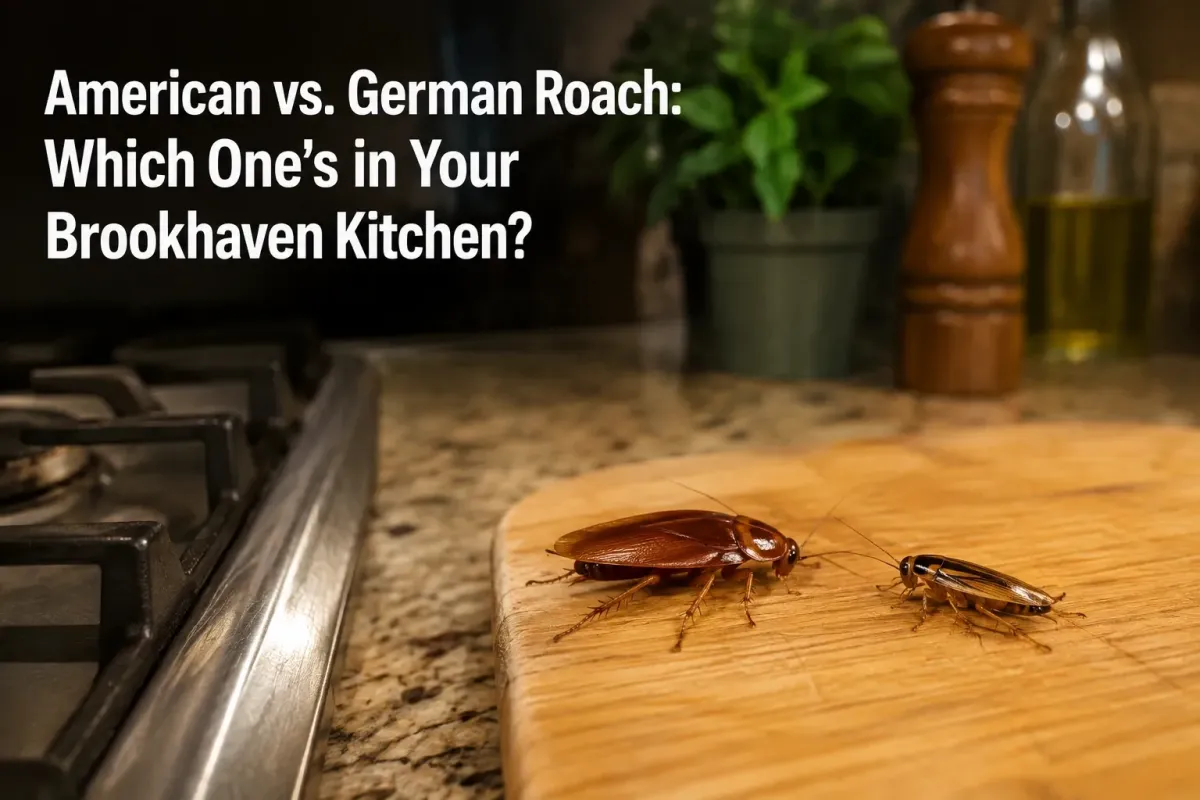
American vs. German Roach: Which One's in Your Brookhaven Kitchen?
American vs. German Roach: Which One's in Your Brookhaven Kitchen?
Flipping on the kitchen light at midnight and seeing a cockroach scatter is unsettling no matter what species it is — but which one you're looking at actually changes how worried you should be, and what it takes to fix it. Brookhaven's mix of older single-family homes, newer construction, and dense condo and apartment buildings creates conditions for both of the region's most common roaches: the German cockroach and the American cockroach. They look, behave, and respond to treatment differently enough that getting the identification right is the first real step toward solving the problem.
Size Is Your Fastest Clue
Before markings or color, size alone tells you most of what you need to know. German cockroaches top out around ⅝ inch — small enough to sit comfortably on a thumbnail. American cockroaches routinely reach 1.5 to 2 inches, closer to the length of your thumb itself. If what you saw genuinely startled you with its size, you're almost certainly looking at an American cockroach.
Meet the German Cockroach
German cockroaches are light tan to light brown, with two dark, parallel stripes running down the shield-like plate just behind the head. They're an exclusively indoor species that rarely, if ever, comes from outside — once established, a German cockroach population lives its entire life cycle inside a structure, favoring warm, humid, food-adjacent spaces like kitchens and bathrooms. They move fast, hide in tight cracks and crevices, and rarely fly.
What makes German cockroaches genuinely concerning is their reproduction rate. A female carries her egg case with her until just before it hatches, and a single female can be responsible for tens of thousands of descendants within a year under the right conditions. This is why a "few roaches" spotted in a kitchen can escalate into a serious infestation within weeks if left untreated — the population most people don't see is almost always larger than the one they do.
Meet the American Cockroach
American cockroaches — sometimes called palmetto bugs — are reddish-brown with a pale yellow, figure-eight-shaped marking behind the head. Unlike German cockroaches, they're often occasional invaders rather than permanent indoor residents: they typically live outdoors or in below-grade spaces like basements, crawl spaces, storm drains, and sewer lines, and move indoors when conditions push them to — heavy rain flooding their outdoor habitat, temperature swings, or simply searching for food and moisture. American cockroaches are also capable fliers, particularly on warm nights, which explains the more startling encounters people report.
Their reproduction is considerably slower than German cockroaches — an American cockroach's egg case holds roughly 16 eggs and isn't carried by the female during incubation — so a single sighting is less likely to represent an established indoor colony and more likely to represent an individual that wandered in from outside.
Why Brookhaven Sees Both
Brookhaven's housing mix plays directly into which species shows up where. Condos, apartments, and multi-unit buildings with shared plumbing and wall voids create the enclosed, moisture-rich conditions German cockroaches thrive in — and because they can migrate between connected units, a single untreated unit can be a persistent reintroduction source for neighbors. Meanwhile, Brookhaven's older single-family homes with basements, crawl spaces, and proximity to Peachtree Creek and its tributaries create exactly the outdoor and below-grade conditions American cockroaches favor, especially after heavy rain pushes them toward higher, drier ground — which sometimes means your kitchen.
Quick Identification Guide
FeatureGerman CockroachAmerican CockroachSize½ – ⅝ inch1.5 – 2 inchesColorTan/light brownReddish-brownMarkingsTwo dark parallel stripes behind the headPale yellow figure-eight marking behind the headHabitatIndoors only — kitchens, bathroomsOutdoors, basements, crawl spaces, drains, sewersFlightRarely fliesCapable flier, especially at nightReproductionVery fast — major infestation riskSlower — often a single wandering individual
Why the Species Changes the Treatment Plan
Because German cockroaches live and breed entirely indoors, effective control requires a targeted, multi-step process — baiting and growth regulators applied directly to harborage sites like cabinet voids, appliance motors, and wall cracks, since the goal is eliminating an established indoor colony, not just the roaches visible at any given moment. American cockroaches, by contrast, often respond well to perimeter treatment and exclusion — sealing gaps around pipes and foundations, addressing moisture sources, and treating outdoor harborage areas — since the underlying population usually lives outside and simply needs to be kept from coming in.
Treating a German cockroach problem like an occasional-invader issue (spraying visible roaches and calling it done) misses the hidden colony entirely. Treating an American cockroach sighting like a full indoor infestation, meanwhile, can mean unnecessary indoor chemical application when the real fix is outside.
Signs You Have an Infestation, Not Just a Visitor
Droppings resembling coffee grounds near cabinets, under sinks, or along baseboards
A musty, oily odor, more noticeable with German cockroach populations as they grow
Multiple sightings over several days, especially at night when lights come on suddenly
Egg cases (oothecae) — small, dark brown, capsule-shaped casings found in cracks or behind appliances
Roaches seen during the day, which for German cockroaches specifically often indicates the indoor population has outgrown its current hiding spots
FAQ SECTION
Q: How do I know if I have German or American cockroaches? A: Size is the fastest indicator — German cockroaches are small, around ½ to ⅝ inch, while American cockroaches are much larger, up to 2 inches. Color and markings confirm it: German cockroaches are tan with two dark stripes behind the head, while American cockroaches are reddish-brown with a pale yellow figure-eight marking.
Q: Which cockroach is worse to have in my home? A: German cockroaches are generally more concerning because they live and breed entirely indoors, reproducing extremely quickly and often going undetected until a population is well established. American cockroaches typically originate outdoors and are more often occasional invaders rather than an established indoor colony, though either can become a genuine infestation if conditions support it.
Q: Why do I keep seeing large cockroaches after it rains in Brookhaven? A: Heavy rain can flood the outdoor and below-grade areas — storm drains, crawl spaces, sewer lines — where American cockroaches typically live, pushing them to seek higher, drier ground indoors. This is a common pattern in areas near creeks and drainage systems.
Q: Do I need different treatment for German vs. American cockroaches? A: Yes. German cockroaches require targeted indoor baiting and treatment of hidden harborage sites to eliminate an established colony. American cockroaches often respond better to perimeter treatment and exclusion, since the population usually lives outside and the goal is keeping it from coming in.
Q: Can cockroaches from one condo unit spread to mine in Brookhaven? A: Yes, particularly with German cockroaches in multi-unit buildings. They can migrate between connected units through shared wall voids and plumbing chases, meaning an untreated neighboring unit can be an ongoing reintroduction source even after your own unit is treated.
Not Sure Which One You're Dealing With?
A clear description or photo is often enough for a preliminary identification, and a professional inspection confirms exactly what's in your home and which treatment approach actually fits.
Have a pest problem? Call Max Pest Solutions at 404-424-9200.
