
7 Signs of Cockroaches in Your Alpharetta Home (And What to Do About It)

Key Takeaways
- Alpharetta’s humid subtropical climate gives cockroaches warm, moist conditions nearly year-round, making early detection especially important for local homeowners.
- The seven main signs of a cockroach infestation are live or dead roaches, droppings, egg cases, smear marks, a musty odor, shed skins, and damage to food packaging.
- German cockroach populations can grow from a handful of individuals to hundreds within a few months under typical indoor conditions in Georgia.
- Cockroach allergens are a documented trigger for asthma and allergic reactions, posing a real health risk beyond simple nuisance.
- Over-the-counter treatments often fail to eliminate established colonies because they do not reach roaches hiding inside wall voids and other concealed harborage points.
- Scheduling a professional inspection in late winter or early spring, before populations peak, is the most proactive way to prevent a serious infestation.
Table of Contents
Signs of cockroaches in your Alpharetta home include live or dead roaches, dark droppings, egg cases, smear marks, a musty odor, shed skins, and damage to food packaging or paper. Alpharetta’s humid subtropical climate, with warm summers and mild winters, gives cockroaches nearly year-round conditions to breed and spread indoors. Spotting even one of these signs early can prevent a minor problem from becoming a serious infestation.
Why Alpharetta Homes Are Especially Vulnerable
Alpharetta sits in Fulton County, Georgia, where average summer humidity regularly exceeds 70 percent. Cockroaches need three things to thrive: warmth, moisture, and food. The region’s climate delivers all three for most of the year.
The most common species found in Alpharetta homes are the American cockroach (Periplaneta americana), the German cockroach (Blattella germanica), and the Oriental cockroach (Blatta orientalis). Each species has slightly different habits, but all of them reproduce quickly. A single German cockroach egg case, called an ootheca, can contain up to 48 eggs. Left unchecked, one female can contribute to thousands of descendants within a year.
New construction and renovation activity, which is common across Alpharetta and surrounding Forsyth County, can also displace roaches from neighboring properties and drive them into established homes.
For homeowners who want professional backup, Max Pest Solutions serves Alpharetta with targeted residential and commercial treatment plans built around Georgia’s specific pest pressures.
The 7 Signs of Cockroaches in Your Alpharetta Home
1. Live or Dead Cockroaches
Seeing a live cockroach during the day is one of the clearest warning signs. Cockroaches are nocturnal. When they appear in daylight, it usually means the population has grown large enough that competition for hiding space is pushing them out into the open.
Dead cockroaches found near baseboards, under appliances, or inside cabinets are equally telling. A single dead roach in a rarely used area warrants a closer inspection of the rest of the home.
Common daytime hiding spots include:
- Behind and under refrigerators and dishwashers
- Inside wall voids near pipes
- Under bathroom and kitchen sinks
- Inside cardboard boxes stored in garages or basements
2. Cockroach Droppings
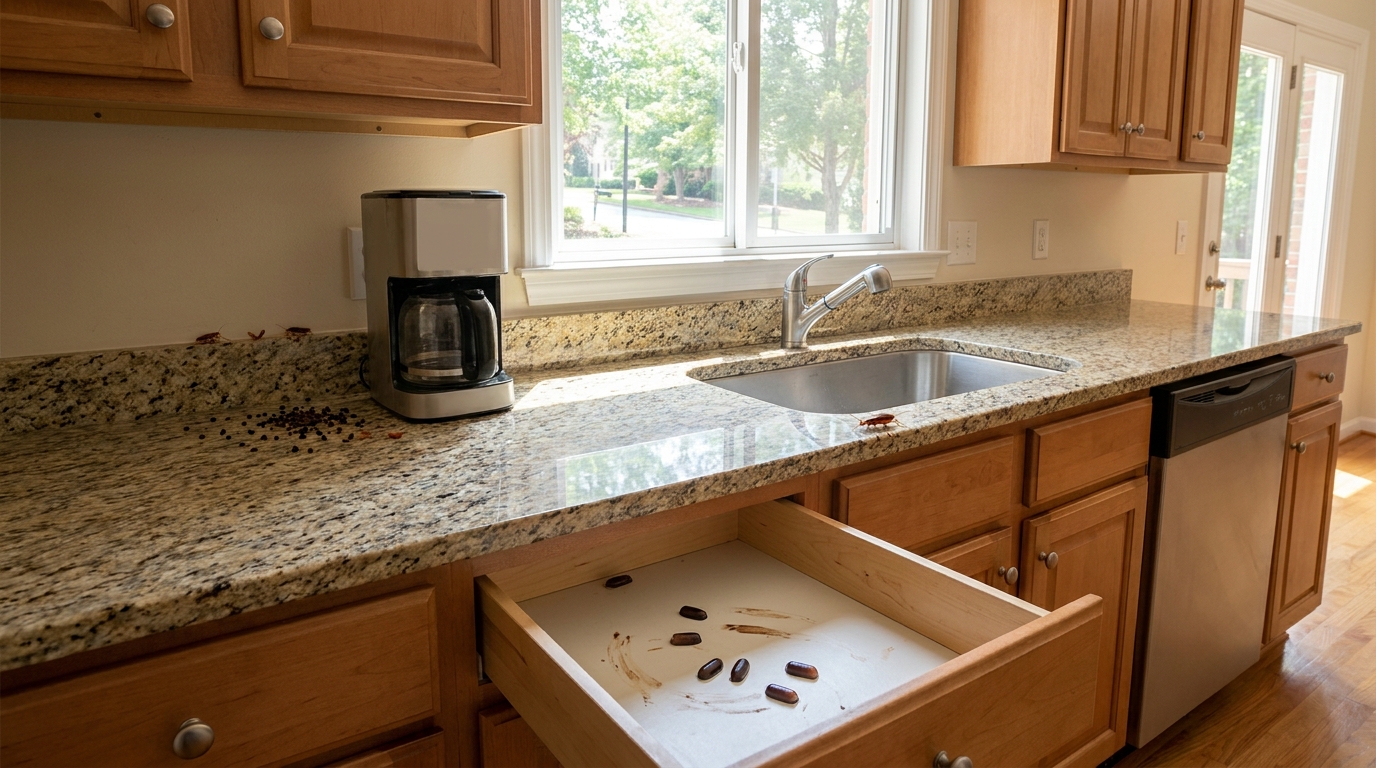
Cockroach feces is one of the most reliable early indicators of an infestation. The appearance varies by species. German cockroach droppings look like black or dark brown specks similar to ground pepper or coffee grounds. American cockroach droppings are larger, cylindrical, and may have ridged sides.
High-volume droppings near food prep areas, inside drawers, or along the tops of cabinets indicate an active, established colony. Droppings also contain pheromones that attract other roaches, which is why infestations tend to concentrate in the same areas over time.
3. Egg Cases (Oothecae)
Cockroach egg cases are small, brown, pill-shaped capsules. Finding one inside a cabinet or behind a piece of furniture is a sign that breeding is already happening in the home.
German cockroach oothecae are roughly 6-9 mm long and light brown. American cockroach oothecae are darker and slightly larger, around 8 mm. Oriental cockroaches produce a distinctly reddish-brown case.
Because females often deposit oothecae in hidden, protected spots, finding even one case suggests there are likely more that are not yet visible.
4. Smear Marks
In areas with higher moisture, cockroaches leave dark, irregular smear marks along walls, baseboards, and surfaces where they travel repeatedly. These marks are a combination of fecal matter and body oils.
In Alpharetta, smear marks are particularly common near plumbing under sinks, along the base of walls in laundry rooms, and around water heater closets. If a home has experienced any water intrusion or has older plumbing that produces condensation, those zones are worth checking first.
5. A Musty or Oily Odor
A persistent musty, oily, or slightly sweet smell with no obvious source is a recognized sign of a cockroach infestation. Cockroaches produce aggregation pheromones and oleic acid as part of their natural biology. In a large infestation, these compounds build up to the point where humans can detect them.
The smell is strongest in enclosed areas where roaches congregate, such as inside wall voids, under appliances, and in tight cabinet spaces. If a kitchen, bathroom, or basement has a stale, unidentifiable odor that does not clear with cleaning, cockroaches should be considered as a possible cause.
6. Shed Skins
Cockroaches molt (shed their exoskeleton) multiple times as they grow from nymph to adult. Each roach passes through several nymphal stages, shedding its skin at each stage. In an active infestation, discarded skins accumulate in areas where roaches hide and rest.
Shed skins look like hollow, translucent versions of the cockroach itself, often found in clusters. Discovering multiple shed skins in one location is a strong indicator that a colony is actively growing nearby.
7. Damage to Food Packaging and Paper
Cockroaches chew through cardboard, paper bags, thin plastic wrapping, and food packaging to access what is inside. Irregular gnaw marks or small holes in pantry items, cereal boxes, or pet food bags are a practical sign of cockroach activity.
They also consume non-food items such as book bindings, wallpaper paste, and cardboard boxes, especially in storage areas. In Alpharetta homes with attached garages used for storage, this kind of damage is often noticed first in that space rather than inside the living areas.
What to Do When You Find These Signs
Inspect Methodically
Once a sign is detected, a systematic inspection helps establish the extent of the problem. Use a flashlight to check behind and under all kitchen appliances, inside every cabinet, under sinks in both kitchens and bathrooms, around the water heater, and in any area of the home with plumbing access.
Focus on the junction of walls and floors, the undersides of shelves, and the interiors of any cardboard box stored in the home. Document what you find, including which type of evidence and in what locations.
Remove Conditions That Support Cockroaches
Cockroaches thrive when food, water, and shelter are easy to find. Several immediate steps reduce the habitat:
- Store all food, including pet food, in sealed, hard-sided containers
- Fix leaking pipes and faucets promptly
- Clean up grease buildup behind stoves and around oven seals
- Remove cardboard boxes and replace with plastic bins
- Seal cracks around pipes and along baseboards with caulk
- Keep garbage bins tightly sealed and emptied regularly
In Alpharetta’s climate, reducing indoor moisture is especially important. Running bathroom and kitchen exhaust fans, checking for condensation around pipes, and maintaining the air conditioning system help lower the humidity that cockroaches depend on.
Consider Professional Treatment
Over-the-counter products can suppress visible cockroach activity temporarily, but they rarely eliminate an established colony. German cockroaches in particular are known to develop resistance to common insecticide classes, including pyrethroids. A professional inspection identifies the species, locates the harborage points, and selects treatments that are appropriate for the infestation level.
Max Pest Solutions is based at 6535 Shiloh Rd #600, Alpharetta, GA 30005 and can be reached at +1404-424-9200. The team offers residential pest control services designed to address cockroach infestations at every stage, from initial treatment to ongoing prevention.
For businesses in the area dealing with cockroach pressure in food service, retail, or office environments, commercial pest control options are also available.
How Georgia’s Climate Shapes Cockroach Behavior Year-Round
Alpharetta’s climate does not produce true winters cold enough to kill cockroaches or drive them into extended dormancy. The average low in January in the Atlanta metro area is around 34 degrees Fahrenheit, but indoor environments remain heated throughout the year, giving cockroaches a stable environment to breed continuously.
Spring and early summer see the largest spikes in cockroach activity as populations expand and nymphs from winter egg cases mature. Summer heat and humidity further accelerate breeding cycles. Fall often brings American cockroaches indoors as they seek shelter from cooling outdoor temperatures.
Understanding this seasonal pattern helps homeowners stay proactive. Scheduling an inspection in late winter or early spring, before populations peak, is more effective than waiting until an infestation is obvious.
Prevention Tips Specific to Alpharetta Homes
Prevention requires consistent attention to the conditions cockroaches exploit. A few practices are particularly relevant in this region:
Manage exterior entry points. American cockroaches commonly enter through gaps around utility lines, weep holes in brick veneer, and gaps under exterior doors. Alpharetta homes with crawl spaces should have properly sealed crawl space vents and vapor barriers to reduce the moisture that attracts Oriental cockroaches.
Watch garage and basement areas. Attached garages in Alpharetta are a common entry point, especially during summer when doors are opened frequently. Keeping the garage organized and sealed reduces harborage opportunities.
Coordinate with neighbors. In high-density neighborhoods and townhome communities, which are plentiful in Alpharetta’s newer developments, a cockroach problem in one unit can migrate easily to adjacent properties. Community-level treatment is sometimes necessary.
Schedule regular inspections. Even when no signs are visible, annual or semi-annual inspections by a licensed pest control company catch problems before they escalate.
Frequently Asked Questions
How quickly can a cockroach infestation grow in an Alpharetta home?
A German cockroach population can double roughly every few weeks under favorable conditions. A single female produces multiple oothecae over her lifetime, each containing 30 to 48 eggs. In a warm, humid Alpharetta home with accessible food and water, a small initial population can grow into hundreds or thousands of individuals within a few months. Early detection is the most effective way to prevent this progression.
Are cockroaches in Alpharetta dangerous to human health?
Yes. Cockroaches are documented carriers of bacteria including Salmonella and E. coli, which they spread by moving between unsanitary areas and food preparation surfaces. Their shed skins and feces contain proteins that are a known trigger for asthma and allergic reactions, particularly in children. The Asthma and Allergy Foundation of America identifies cockroach allergens as one of the leading indoor asthma triggers in the United States.
Can I handle a cockroach infestation on my own?
Minor infestations caught very early can sometimes be controlled with gel baits, boric acid treatments, and improved sanitation. However, because cockroaches hide in wall voids and other inaccessible areas, most do-it-yourself treatments address only the visible portion of the population. German cockroaches in particular require precise bait placement and may need multiple treatment cycles. For any infestation that involves multiple rooms, recurring sightings, or confirmed egg cases, professional treatment is the more reliable path to full elimination.
What is the difference between American and German cockroaches in terms of where they hide?
American cockroaches, which can grow to 1.5 inches or longer, typically prefer moist, dark areas such as sewer lines, crawl spaces, floor drains, and the exterior perimeter of a home. They often move indoors through drains or gaps in foundations. German cockroaches are smaller, around half an inch to five-eighths of an inch, and strongly prefer indoor kitchen and bathroom environments. They cluster close to food and water sources and rarely venture outdoors. Knowing the species guides where inspections and treatments should focus.
How do I know if my cockroach problem requires professional pest control?
If you find more than one or two signs from the list above, see roaches during the day, notice droppings in multiple rooms, or find egg cases, the infestation is likely beyond what sanitation improvements alone can resolve. At that point, contacting a licensed pest control company is the recommended step. Max Pest Solutions can be reached at +1404-424-9200 or through maxpestsolutions.com to schedule an inspection and discuss treatment options suited to your home’s specific situation.