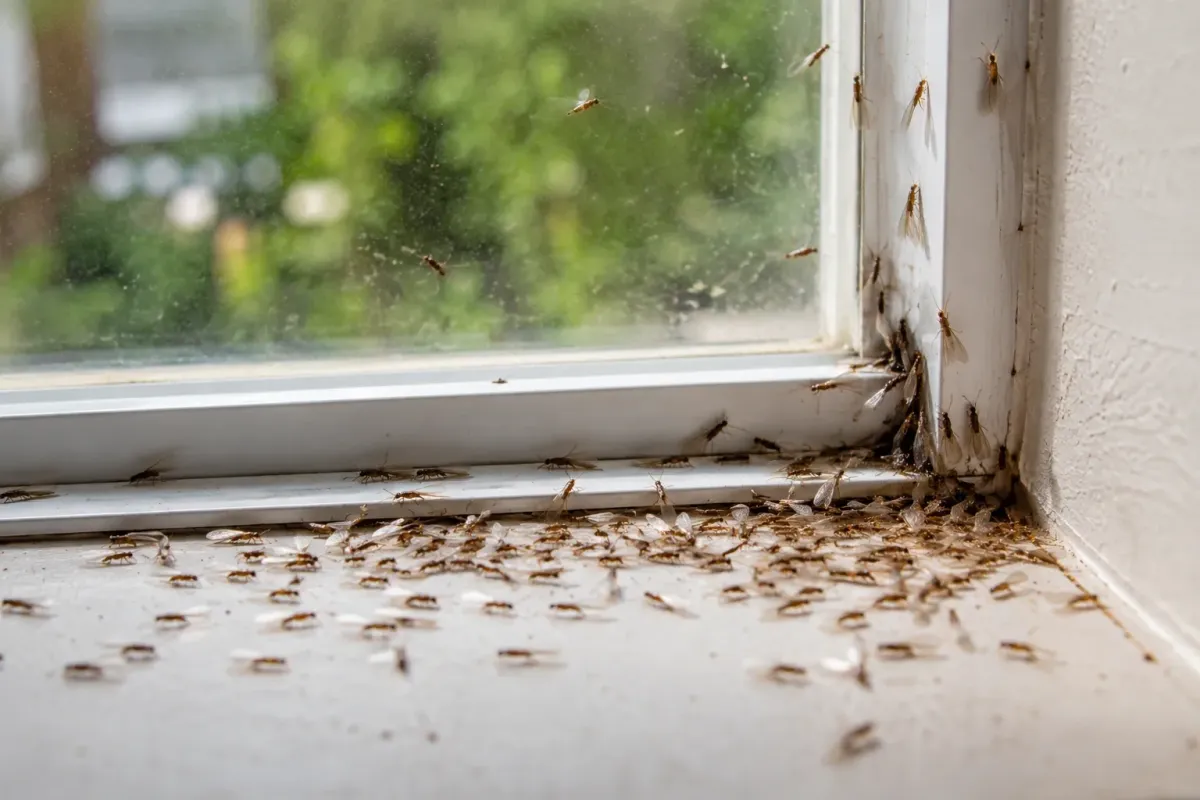
Termite Swarm Season in Alpharetta
Termite Swarm Season in Alpharetta: What to Do If You See Winged Insects
A sudden cluster of winged insects near a windowsill, or a pile of discarded wings on the floor, is one of the more alarming things a homeowner can find — and for good reason. It could mean nothing more than a harmless ant colony reproducing outside. Or it could mean a termite colony has matured enough to send out its next generation, potentially from a colony that's already feeding on your home. Telling the two apart takes about ten seconds once you know what to look for, and what you do in the minutes after matters almost as much as the identification itself.
When Swarm Season Hits Alpharetta
Eastern subterranean termites — the species responsible for the vast majority of termite damage in North Georgia — typically swarm from March through May, with activity often triggered by warming soil temperatures and a rain event that raises humidity. Carpenter ants, one of the more common look-alikes, tend to swarm slightly later, from roughly May through July. That overlap means late spring is the highest-confusion window of the year, which is exactly why identification matters more than a guess.
The 10-Second Test: Termite or Flying Ant?
You don't need an entomology background to tell these apart — three quick checks settle it almost every time.
1. Look at the waist. Termites have a thick, straight body with no visible narrowing between the thorax and abdomen — it looks almost like a single tube. Flying ants have a distinct pinched, hourglass-shaped waist that clearly separates the body into three visible segments.
2. Look at the wings. Termite swarmers have four wings that are all the same length, often described as roughly twice the length of the body, and pale or translucent. Flying ants have four wings too, but the front pair is noticeably longer than the back pair, and the wings tend to have a slight tint.
3. Look at the antennae. Termite antennae are straight, made of small bead-like segments in a nearly rigid line. Ant antennae are visibly "elbowed" — bent sharply partway down, almost at a right angle.
If you're still unsure, one more detail helps: termites shed their wings almost immediately after swarming, which is why a small pile of matching, uniform wings near a windowsill or door is one of the strongest termite indicators there is. Flying ants tend to keep their wings longer and are less likely to leave a discarded pile behind.
Why the Difference Matters So Much
Flying ants are, for the most part, a short-term nuisance — they don't eat or damage wood, and an outdoor swarm rarely indicates any threat to your home's structure. Termites are a different category of problem entirely. A swarm means a colony nearby has matured enough to reproduce, and termites cause billions of dollars in structural damage nationally each year, precisely because they feed on wood from the inside, out of sight, for years before visible damage appears. Misidentifying a termite swarm as "just flying ants" can mean months or years of unaddressed feeding before the problem becomes obvious on its own.
Indoors vs. Outdoors: Does Location Change the Urgency?
Swarmers seen outdoors, away from the home — in mulch beds, near tree stumps, or in the yard generally — are less urgent, though still worth noting the location and date in case it becomes relevant later. Termite colonies can exist in the yard without directly threatening the structure, at least not immediately.
Swarmers seen indoors, or immediately around the foundation, doors, or windows, are a different situation entirely. An indoor swarm strongly suggests the colony that produced it is either already inside the structure or immediately adjacent to it, since swarmers are relatively weak fliers and don't typically travel far from their point of origin. This scenario warrants a prompt professional inspection rather than a wait-and-see approach.
What to Do the Moment You See Swarmers
Don't clean up the wings right away. A small container or a phone photo of the pile, with a note of the location, gives a technician useful information about where activity is concentrated.
Note the date and location. Indoor sightings, especially near a specific wall, window, or floor area, help pinpoint where a colony may be accessing the structure.
Check nearby areas for mud tubes, pencil-width tunnels typically found along foundation walls or in crawl spaces, which indicate an established subterranean termite presence.
Schedule a professional inspection, particularly for any indoor sighting or one near the foundation — a licensed inspection can confirm species, locate the colony's likely access point, and determine whether existing damage is present.
What NOT to Do
Don't spray the swarmers with general insecticide and consider it handled. Killing the visible swarmers does nothing to address the colony that produced them, which continues feeding regardless.
Don't assume it's "probably just ants" without checking. The visual differences are small enough that a confident-sounding guess is still frequently wrong, especially during the spring window when both species are active.
Don't wait for additional visible damage before acting. By the time termite damage is visible — sagging floors, hollow-sounding wood, stuck doors — a colony has typically been feeding undetected for years already.
FAQ SECTION
Q: How can I tell if winged insects in my Alpharetta home are termites or flying ants? A: Check three things: the waist (termites are straight and tube-like; ants have a pinched, hourglass waist), the wings (termite wings are all the same length; ant front wings are noticeably longer than the back pair), and the antennae (termites are straight; ants are sharply bent). A pile of discarded, uniform wings near a windowsill is also a strong termite indicator.
Q: When is termite swarm season in Georgia? A: Eastern subterranean termites, the most common species in North Georgia, typically swarm from March through May, often triggered by warming soil and a rain event. Carpenter ants, a common look-alike, tend to swarm slightly later, from May through July.
Q: I found termite wings on my windowsill but no live insects. Should I still be concerned? A: Yes. Discarded wings indicate a swarm already occurred, and termites shed their wings almost immediately after landing to find a mate, so wings alone are a strong sign that swarming activity happened at or very near that location — worth a professional inspection even without live insects present.
Q: Does seeing termite swarmers outside mean my house is at risk? A: It depends on proximity. Swarmers seen well away from the structure are less immediately concerning, though worth noting. Swarmers seen indoors or right at the foundation, doors, or windows suggest the colony is close to or already inside the structure and warrant a prompt inspection.
Q: Can I just spray the swarmers I see and consider the problem solved? A: No. Killing the visible swarmers doesn't address the underlying colony, which will continue feeding on the structure regardless. A professional inspection is the only way to confirm whether an active colony is present and locate where it's accessing the home.
Seeing Swarmers Right Now?
Don't wait to find out which one it is. Max Pest Solutions offers free termite inspections for Alpharetta homeowners to confirm what you're dealing with and identify any existing activity before it becomes a bigger problem.
Have a pest problem? Call Max Pest Solutions at 404-424-9200.
